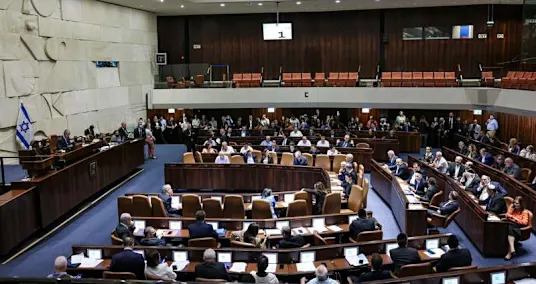
Israel's parliament on Monday approved a controversial bill to reintroduce the death penalty for terrorists, a move considered racist by critics as the legislation would effectively only apply to Palestinians.
Rights organizations and several European countries had called for the initiative to be stopped.
Under the bill, Palestinians convicted of murder as an act of terrorism by military courts in the occupied territories would face a mandatory death sentence.
In civilian courts in Israel, meanwhile, a person convicted of murder with a terrorism motive with the aim of destroying the State of Israel could be sentenced either to death or to life imprisonment under the law.
The bill was introduced by the Otzma Yehudit party of far-right Minister of National Security Itamar Ben-Gvir.
A total of 62 of 120 lawmakers in the Knesset backed the bill in a final vote on Monday, including Prime Minister Benjamin Netanyahu. A total of 48 lawmakers voted against the bill, while the rest abstained or were not present for the vote.
LATEST POSTS
- 1
 New movies to watch this week: See 'Marty Supreme' in theaters, rent 'Springsteen: Deliver Me from Nowhere,' stream 'Cover-Up' on Netflix
 - 2Moon-bound Artemis II astronauts enjoy a relaxed day in space
- 3Extraordinary Picks for Home Apparatuses: Making Life Simpler
- 4'No Kings' protests recap: More than 8 million turned out across all 50 states, organizers say
- 5Industrial zone damaged in Negev, falls in Sharon area after Iran fires missiles towards Israel





- Freed whale gets stranded again off German coast
- Four Dead in Last Month From Animal Attacks in Nepal
- The moon and sun figure big in the new year's lineup of cosmic wonders
- 37 Things Just Individuals Experiencing childhood during the 80s Will Comprehend
- Ageless Tastefulness: An Outline of Valuable Gemstones and Adornments
- Sustaining Public activity and Connections: Key Methodologies
- The Best Internet based Courses for Expertise Improvement
- Artemis 2 astronauts — now halfway to the moon — report 'burning smell' from toilet, but everything's fine
- Turkey key underlying issue as Israel, Greece, Cyprus hold summit